OCR · A level · H446

OCR H446 A Level Computer Science lessons, built from your specification

For A level Computer Science teachers working through OCR's H446 specification. Lesson Studio builds slides, a support, core and stretch worksheet with a mark scheme, and teacher notes from the H446 points you tick.

Free sample lesson pack

A whole H446 lesson to download and teach. No sign-up needed.

Representing negative numbers in binary

  • Year 12
  • 55 minutes
  • 1.4.1 Data Types

Sign and magnitude and two's complement in four bits: representing negative numbers both ways, reading the same bit pattern under each, and why their ranges differ.

The H446 course map

Every topic area in the specification, ready to plan lessons against.

Component 01

Computer systems

  1. 1.1

    The characteristics of contemporary processors, input, output and storage devices

    What goes on inside the CPU as it runs a program, how processor designs compare, and the hardware that gets data in, out and kept.

  2. 1.2

    Software and software development

    Operating systems and the software around them, how applications are chosen and built, development methodologies, and the kinds of programming language.

  3. 1.3

    Exchanging data

    Compressing, encrypting and hashing data, relational databases and SQL, how networks and the internet move data, and how the web works.

  4. 1.4

    Data types, data structures and algorithms

    How numbers and text are held in binary, the structures programs keep data in, and Boolean logic for describing and simplifying circuits.

    Free sample lesson in this topic area
  5. 1.5

    Legal, moral, cultural and ethical issues

    The UK laws that apply to computing, and the wider questions technology raises for people, society and the environment.

Component 02

Algorithms and programming

  1. 2.1

    Elements of computational thinking

    The habits of mind that turn a problem into something a computer can solve: leaving out detail, planning ahead, breaking it down, deciding and doing things at once.

  2. 2.2

    Problem solving and programming

    Writing programs with the core constructs, subroutines, recursion and object-oriented techniques, and choosing a strategy to solve a problem by computer.

  3. 2.3

    Algorithms

    Designing and comparing algorithms, including their efficiency, and the standard searching, sorting and path-finding algorithms with the data structures they work on.

Component 03 or 04

Programming project

Non-exam assessment (NEA)
  1. 3.1

    Analysis of the problem

    Pupils choose a problem, show why it suits a computer solution, research it with the people it is for and set out how success will be judged.

  2. 3.2

    Design of the solution

    Breaking the problem into parts, setting out the structure and algorithms of the solution, and planning how it will be tested.

  3. 3.3

    Developing the solution

    Building the program in stages, with evidence of each version and the testing that shaped the next.

  4. 3.4

    Evaluation

    Testing the finished program against its success criteria, judging how usable it is, and how it could be maintained and taken further.

Component and topic area headings are from OCR's H446 specification; the summaries are our own. Read the full specification on OCR's H446 specification page.

The sample lesson in Lesson Studio

Real screenshots: the H446 specification added to a spec library, and the sample lesson built from it.
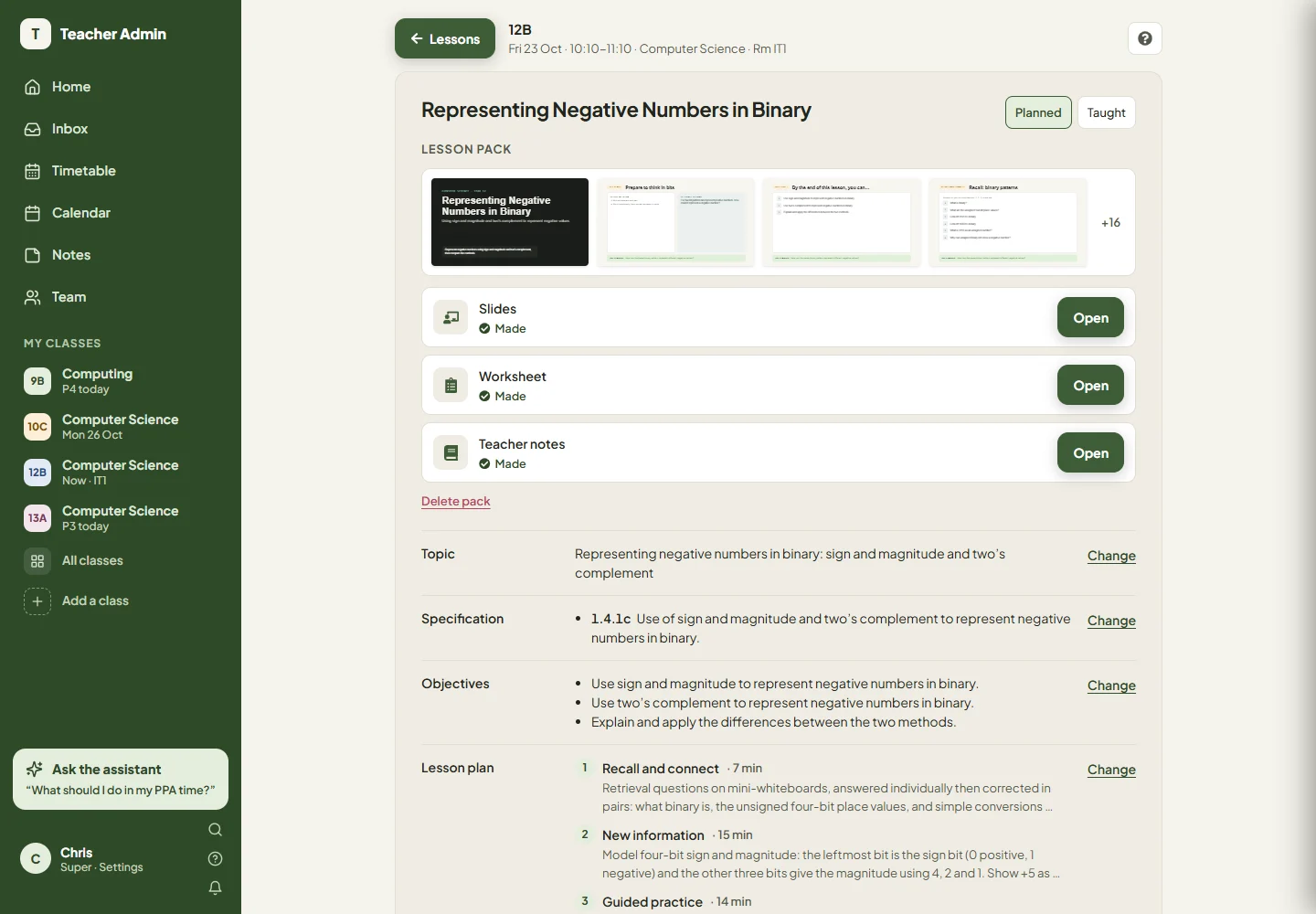
A Year 12 Computer Science lesson's overview, Representing Negative Numbers in Binary: its lesson pack of slides, worksheet and teacher notes, then H446 specification point 1.4.1c on sign and magnitude and two's complement, and three learning objectives in the same words
Planned from the specification

The H446 point, then objectives to match

The lesson keeps the specification point it was planned from, and its objectives are drafted from that point's own wording.
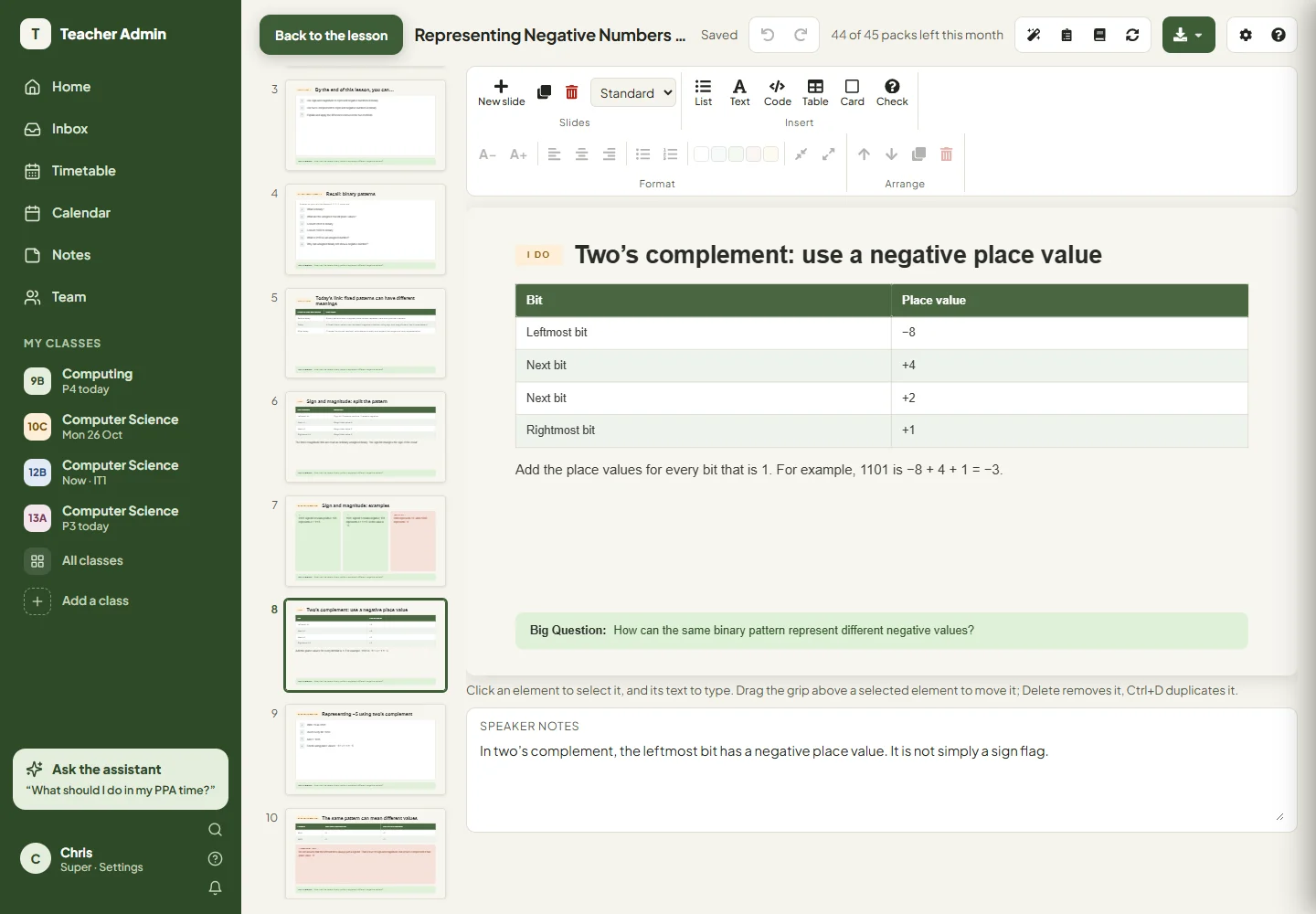
Lesson Studio slide editor for the 12B Computer Science lesson: an I do slide, Two's complement: use a negative place value, with a table giving the leftmost bit -8 and the others +4, +2 and +1, a worked example for 1101, and speaker notes underneath
The slides

Teaching slides, ready to edit

Worked examples, checks for understanding and speaker notes, built from the plan. Change anything in the browser, then download for PowerPoint.
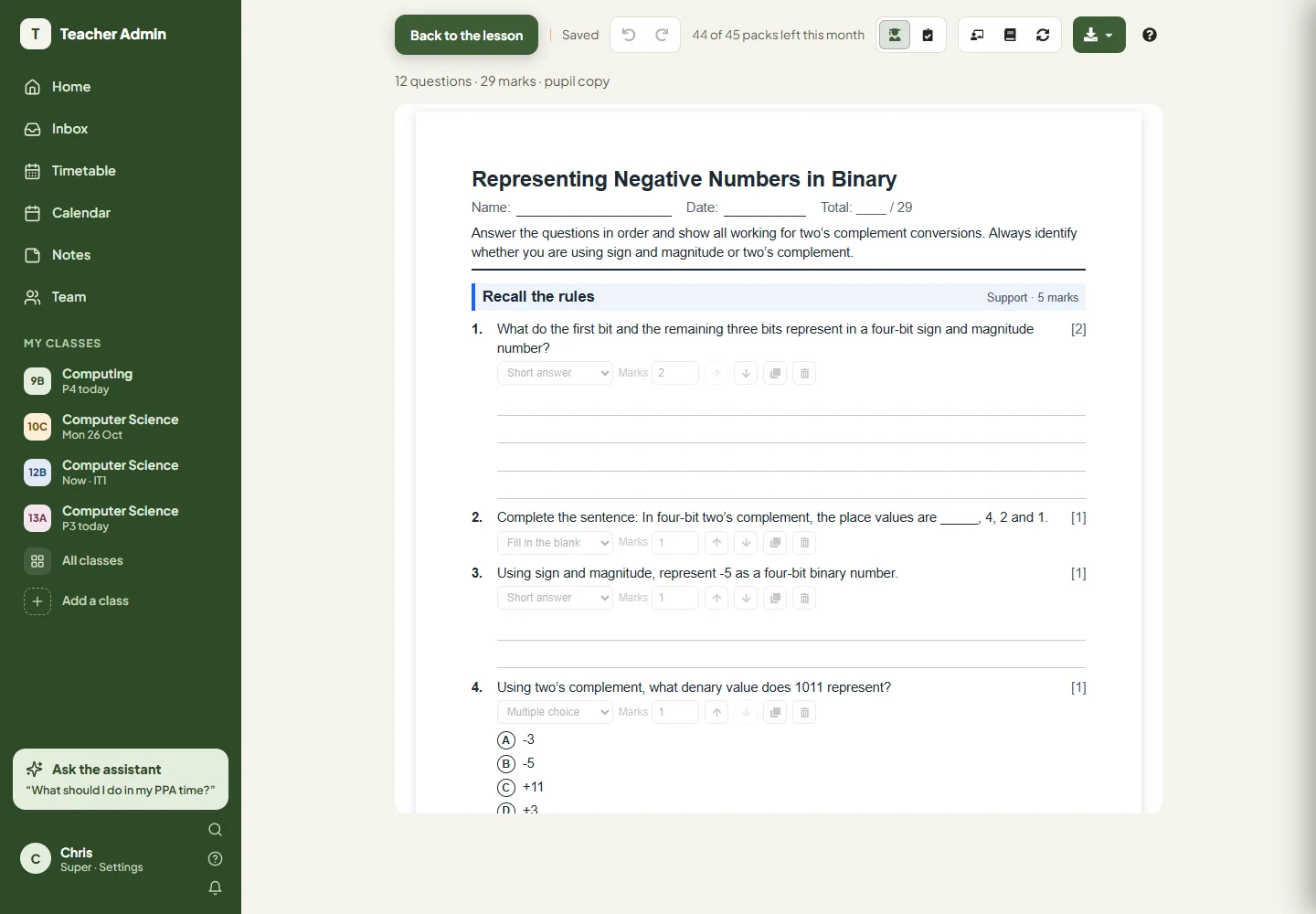
Worksheet for Representing Negative Numbers in Binary with name, date and a total out of 29, then the Recall the rules support section of short-answer, fill-in-the-blank and multiple-choice questions, each with its marks
The worksheet

Support, core and stretch

Three sections that climb from recall to explanation, each question with its marks, and a mark scheme to go with it.

How it works

Three steps from the H446 PDF to a lesson you can teach.

1

Upload the spec

Add OCR's H446 PDF to your spec library once. It is read in your browser and split into its numbered points. How spec-aligned planning works, or turn it into a pupil checklist with the free PLC generator

2

Tick the points

Open a lesson and tick the H446 points it covers. The plan's objectives are drafted in the specification's own words.

3

Build the pack

Lesson Studio builds the slides, the worksheet with its mark scheme, and the teacher notes from that plan. Edit them, then download. See the slides generator, or how it compares with Chalkie

Frequently asked questions

Can I use it to prepare pupils for the programming project?
Yes. Plan NEA preparation lessons the same way, for example on analysis, design or testing. It builds teaching resources for you, not project work for pupils.
Does it plan the whole course at once?
No. You build one lesson at a time, ticking the specification points each lesson covers, so every pack matches what you are teaching that week.
Can I share the packs with my department?
Yes. Once downloaded, packs are PowerPoint and Word files you can share with anyone.
Does the free trial include spec-aligned packs?
Yes. Every new account gets 7 days of Pro, including 3 Lesson Studio packs built from your own specification. No card needed.

Plan your next H446 lesson from the specification

Add the H446 specification, tick the points and get the whole pack. Lesson Studio is part of Super: £7.49 a month or £69.99 a year, with everything in Pro included.

Try 3 lesson packs free Get Super

Every new account gets 7 days of Pro, including 3 Lesson Studio packs. No card needed.