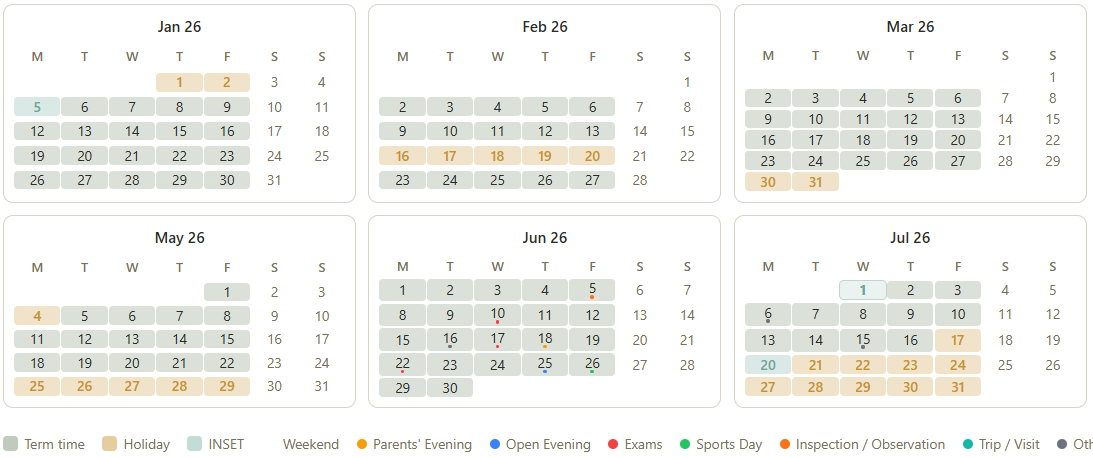
UK School Term Dates and INSET Days: Why Your Planner Should Know Them Already
Every generic calendar app treats a school year like any other year: fifty two identical weeks, no concept of half term, no idea that the first week back after Christmas runs differently to the rest of January. If you have ever manually blocked out INSET days in Google Calendar, or re-added the same six holiday periods every September, you have felt the gap this creates.
It seems like a small thing. It isn't, and here's why it's worth fixing properly rather than working around it again this year.
The manual re-entry problem compounds
Term dates change every year, and they differ by local authority, by academy trust, and sometimes by individual school. A generic calendar has no idea any of this exists, so every September you are back to manually entering the same categories of date: term start and end, half terms, INSET days, exam windows, parents' evenings. Multiply that by the years you'll do this job and it is not a small task, it is a recurring tax you pay every single academic year for no reason other than the tool not understanding what a school year is.
INSET days get lost precisely because they're irregular
Bank holidays are the same every year and every calendar app already knows them. INSET days are the opposite: set by your school, they move year to year, and they are exactly the kind of date that falls through the cracks of a generic system because nothing prompts you to add them. The result is the familiar scramble: finding out an INSET day is tomorrow from a WhatsApp group rather than your own planner, because your planner never knew to ask.
Term-aware planning changes what "on track" means
A calendar that understands term structure can tell you something a generic one cannot: whether you're actually on pace, given how many teaching weeks are left before the next break, not how many calendar weeks. Six teaching weeks with a half term in the middle plans very differently to six uninterrupted weeks, and most workload stress in the run-up to a holiday comes from planning as if the second scenario is happening when it's actually the first.
What to actually look for in a school planner
If you are choosing a digital planner or calendar for the coming year, term-awareness is worth prioritising over almost any other feature, because it is the one thing a generic tool structurally cannot do well. Specifically:
- Does it know your term dates and half terms without you entering them by hand each year?
- Does it separate INSET days and training days from ordinary non-contact time?
- Does it let deadlines and marking be scheduled against teaching weeks, not calendar weeks?
- Does it carry over next year without starting from a blank calendar again?
A teacher calendar app built around UK term dates and INSET days answers yes to all four by design, because it is built around how a school year actually runs rather than a generic twelve-month grid.
It's also worth checking whether the planning app itself understands any of this, not just your calendar. Several widely used teacher planning apps, Planboard included, are built around US and Canadian curriculum standards and have no concept of a UK half term or INSET day at all, so the gap gets filled by the teacher rather than the tool. How Teacher Task Manager compares as a Planboard alternative for UK schools sets out exactly where that shows up.
The honest bottom line
This is not a feature you'll notice you're missing until September, when you're re-adding the same dates you added last September. A calendar built around the shape of a school year removes that admin permanently rather than asking you to redo it every single year.