How to Reduce Teacher Workload Without Cutting Corners
Workload advice for teachers tends to fall into two camps. One tells you to work smarter, usually meaning some vague call to "prioritise better" that ignores the fact your week is already full of things that cannot be dropped. The other tells you to simply do less, which is fine advice for someone who sets their own targets and useless for someone accountable to a headteacher, a curriculum, and thirty sets of parents.
Neither is much use on a Tuesday night with three classes still to mark. Here is what actually moves the needle, based on where teacher workload research and the daily reality of the job actually overlap.
The workload is not the marking. It's the marking system.
Most workload advice targets the wrong layer. It tells you to mark faster, or mark less, when the real cost is the overhead around marking: finding where you left off, tracking which class is due when, remembering which pieces need a full written comment versus a quick check. That overhead is invisible admin tax, and it adds up to hours a week that never show up on any workload survey because nobody counts "time spent working out what to do next" as work.
The fix is not a faster marking method. It's removing the tracking overhead so marking starts the moment you sit down, rather than five minutes after. A simple system, digital or paper, that shows you at a glance what's outstanding across every class removes more time than any marking technique will.
Batch by task, not by class
Teachers are trained to think in classes: mark Year 9's books, then Year 10's. Workload researchers consistently find the opposite is faster: batch by task type instead. Do every piece of quick-check marking across all classes in one sitting, then every piece needing a full written comment in a separate sitting. Task-switching between "quick tick" and "deep comment" costs more time than switching between classes does, because your brain has to reset its mode each time, not just its content.
The three-touch rule for admin
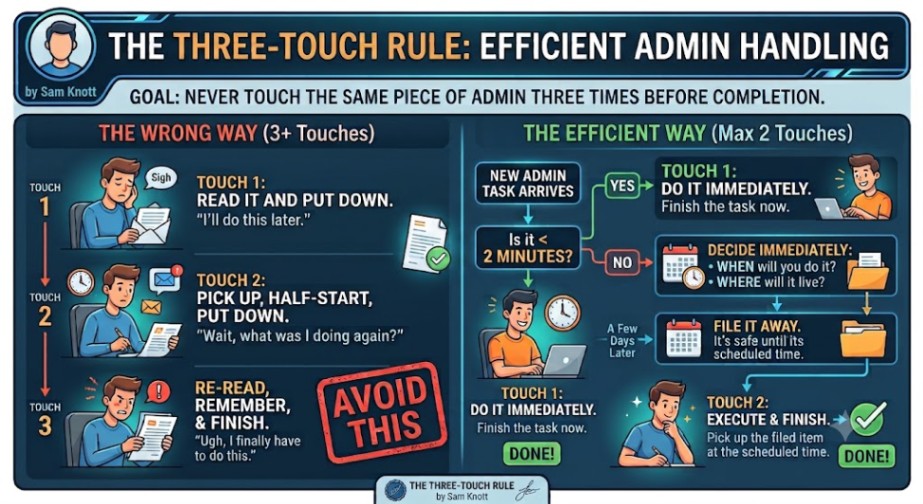
A large share of admin time is not doing the task, it's touching it more than once. An email you read, decide to deal with later, then have to re-read to remember what it said. A form you half fill in, close, and reopen next week having forgotten your place. Each re-touch costs the time to re-orient, not just the time to act.
The rule: if something takes under two minutes, do it the first time you see it. If it takes longer, decide immediately when you will do it and where it will live so the next time you touch it, you finish it. The goal is never touching the same piece of admin three times before it's done.
Protect one deadline-free hour a week
This sounds like advice for people with more control over their week than most teachers have, and it partly is. But it does not need to be an hour with nothing in it. It needs to be one hour that is not reactive: not marking that's due tomorrow, not a form due today, just planning ahead for the two weeks in front of you. Without this, every week is spent reacting to what is already overdue, which is the single biggest driver of the feeling of being permanently behind.
What this actually requires
None of this needs a new app, a new system, or a training day. It needs one thing: somewhere that shows you, honestly, what is outstanding across marking, admin and deadlines, without you having to reconstruct it from memory or six different places. Most teachers are running that system in their head, which is why it collapses under pressure.
For a lot of teachers, the closest thing they already have to this is a lesson planner, and that's solving a different problem: planning what you'll teach next Tuesday doesn't tell you what's still outstanding across marking, admin and deadlines. How a lesson planner like Planboard differs from a full workload tracker is worth knowing before you pick one tool to rely on.
This is the exact problem a marking and task tracker built for teachers is meant to solve: one place that shows outstanding marking, admin and deadlines together, so the overhead of remembering what's left disappears and the actual work can start sooner.
The honest bottom line
Workload will not shrink because you found a better hack. It shrinks when the invisible overhead around the real work, tracking, remembering, re-touching, gets removed. That is a smaller ask than "do less" and a more useful one than "work smarter", and it is the only kind of advice that survives contact with an actual Tuesday.