How to Write Pupil Report Comments Faster Without Sounding Like a Robot
Report season has a specific kind of exhaustion attached to it. It isn't the volume of writing alone, it's writing the same underlying message thirty different ways so that no two comments read identically, while staying accurate to each individual child. That tension, between speed and genuine individuality, is where most report-writing time actually goes.
Here's what helps, and what doesn't.
Sentence banks solve the wrong problem
The standard advice is a bank of pre-written sentences to mix and match. It works, up to a point, and then it creates its own problem: comments start to read as obviously templated, because they are. Parents notice. Senior leaders reading a stack of them notice more. The speed gain from a sentence bank is real, but it is bought at the cost of comments that all sound the same, which defeats part of the point of a report in the first place.
Separate the data from the voice
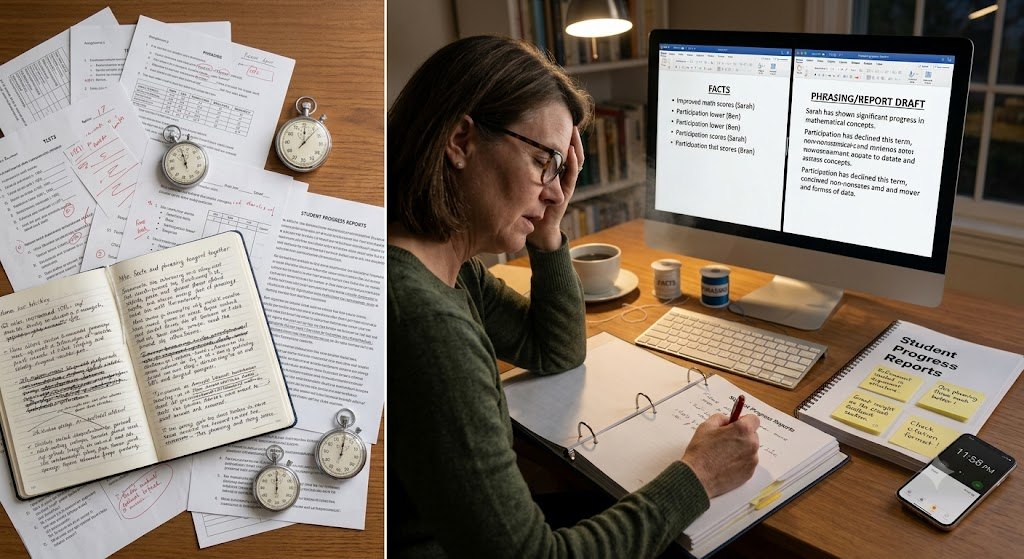
The actual bottleneck in report writing is rarely the writing itself, it's holding two things in your head simultaneously: the specific, factual detail about this child (their grade, their effort level, the one thing that changed this term) and the phrasing that turns it into a sentence that sounds like you and not like a form letter.
The fix is to separate these two jobs rather than doing them at once. Note down the raw facts for every child first, in short fragments, no sentences yet: "improved since October, still rushes written work, strong in discussion." Only once every child has their fragments written do you turn fragments into sentences. This is faster than writing full sentences one child at a time, because you are not switching between "what do I want to say" and "how do I want to say it" thirty separate times.
Use structure to protect individuality, not replace it
A comment built from a fixed structure, one line on attainment, one on effort or engagement, one on a specific next step, is faster to write than a blank page and reads as more individual than a sentence bank, because the specific detail in each line still comes from you. Structure removes the "what do I write next" hesitation without removing your voice, which is the opposite trade-off to a sentence bank.
Write the hard ones first
Save the straightforward, high-attaining, no-concerns pupil for last. The comments that take longest are the ones needing careful framing, a dip you need to note honestly without it reading as harsh, or a strength you want to flag without overpraising. Doing those while you still have full concentration, rather than as the last five of a batch of thirty, produces better writing and takes less time overall, because tired phrasing is slow phrasing.
Where AI genuinely helps, and where it doesn't
AI is good at turning your fragments into a polished sentence in your structure. It is bad at knowing which fragment is true, so the facts still have to come from you. Used this way, the fragments-then-structure method above and an AI assist compound well: you supply the individual truth, the structure protects your voice, and the AI removes the pure mechanical time of typing thirty full sentences from thirty sets of notes.
This is the exact shape of the AI-assisted report comment generator built for teachers: you give it the real detail for each pupil, it turns that into a comment in your structure, so report season becomes an editing pass rather than a writing marathon from a blank page.
The honest bottom line
Report writing is slow when the facts and the phrasing are tangled together and you are doing both at once, thirty times. Separate them, protect the structure, and the speed gain is real without the comments reading as obviously mass-produced. That is the difference that actually matters to a parent reading one comment among many.