The Post-it Note That Started It All
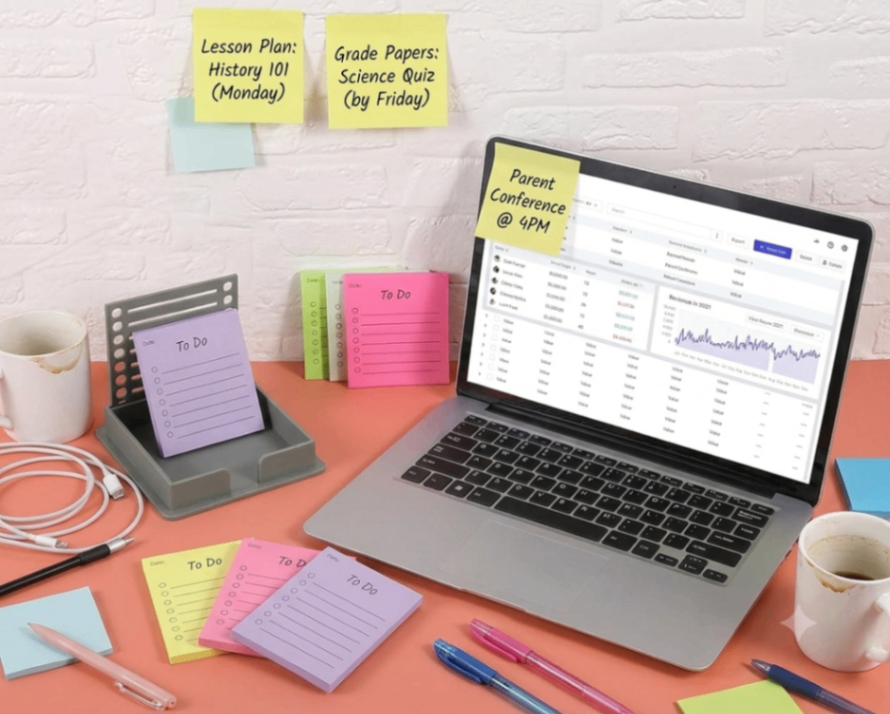
It's 8:14am on a Tuesday. You've got form time in eleven minutes, a Year 9 book scrutiny due by Friday, and a parent emailed last night asking for an update on their son's coursework. You write "Year 9 books" on a Post-it and stick it to your monitor. It joins four others.
None of those four are wrong, exactly. One says "print Y11 mocks." Another just says "DBS renewal??" with two question marks, because past-you clearly meant something urgent and present-you has no idea what. A third has fallen behind the monitor and you won't find it again until the summer clean-out.
This is the bit nobody warns you about in training. Teaching workload doesn't usually arrive as one enormous task. It arrives as thirty small ones, most of which take less than ten minutes each, and all of which live in different places: a sticky note, a diary page, a mental list you're rehearsing while you're meant to be listening to a Year 8 explain why their homework is on a laptop that's "still charging at home."
The maths that never gets said out loud
Say you've got fifteen small admin jobs on the go at any one time. Print something, chase something, reply to something, update a spreadsheet, book a room, flag a safeguarding note, order in a resource. Individually, none of them are hard. Collectively, they need somewhere to live that isn't your short-term memory, because your short-term memory is already doing the actual job of teaching.
A paper planner works fine for this right up until it doesn't. It's brilliant for lesson sequencing and timetabling, because that's what it's built for. It's much less good at holding "email SENCO about the seating plan change" alongside "the interactive whiteboard in room 12 needs a replacement bulb," because those two things have nothing in common except that they're both due sometime this week and both easy to forget the moment the bell goes.
Post-its solve the visibility problem for about four days. Then you've got more of them than desk space, they stop being colour-coded because you've run out of the colour you were using for "urgent," and at least one has ended up stuck to a set of books you handed back, which is a genuinely bad way for a parent to find out you'd written "chase this kid AGAIN" on their child's homework.
What was actually going wrong
The problem was never that teachers are disorganised. It's that the tools weren't built for how the job actually works: a constant stream of small, unrelated, easily-forgotten jobs, arriving from different directions, all competing for the same five minutes of thinking time you get between lessons.
That's the gap I built Teacher Task Manager to close. Not another calendar, and not a to-do list built for office work with fixed hours and one inbox. Something that holds the mess of a teaching day, the ten-minute jobs and the ongoing ones, without needing you to remember where you wrote it down.
If any of this sounds familiar, Teacher Task Manager is built to replace the paper planner itself, timetable, term dates and all, rather than adding one more place to check.
The Post-it on my monitor, by the way, said "fix the thing where Post-its don't scale." It's still there. Some habits are hard to shake, even after you've built the fix.